The heat inside a parked car, and what a shade can honestly do
A measured experiment by the weather service, the part of the problem a windscreen shade actually addresses, and the part no accessory on earth can fix.
Everyone knows a parked car gets hot. Almost nobody has a correct sense of how fast, because the experience of getting into one is smoothed over by opening a door, starting the air conditioning and forgetting about it. The numbers are worse than the memory.
This guide has two halves and they should not be mixed up. The first is comfort: a hot steering wheel, a scorched buckle, a dashboard that ages in the sun. A shade helps with that.
The second is safety, and specifically children and animals left in cars, where no accessory helps at all and the only correct answer is not to do it. We quote the National Weather Service and the National Highway Traffic Safety Administration on that half rather than writing our own version of it. Nothing here is medical advice.
What the weather service measured
The Louisville office of the National Weather Service put a temperature probe inside a parked van with the windows closed and wrote down what happened. The starting conditions were ordinary summer weather, not a desert:
The air temperature was 94 F when the experiment began at 2:09 PM.
National Weather Service, Louisville, Heat in Vehicles Can Become Deadly Quickly. Read 14 August 2026.
And then the climb, minute by minute:
You can see that the temperture exceeds 100 F by 2:15 PM, 110 F by 2:28, and 115 F by 2:37 PM.
National Weather Service, Louisville, Heat in Vehicles Can Become Deadly Quickly. Read 14 August 2026.
Twenty one degrees Fahrenheit above the outside air in six minutes, and the cabin still climbing half an hour later. The service adds the detail that matters most for an ordinary car: the van in the experiment was a large volume, and a smaller cabin heats faster.
Their conclusion is one sentence long and it is the one to remember out of this entire guide:
The National Weather Service reminds everybody to never leave a child or animal in a closed vehicle on a sunny day.
National Weather Service, Louisville, Heat in Vehicles Can Become Deadly Quickly. Read 14 August 2026.
Why a cabin behaves like that
Glass passes short wavelength sunlight easily and blocks much of the longer wavelength heat radiated back by warm surfaces. Light goes in, lands on a dashboard, a seat and a steering wheel, turns into heat, and most of it cannot leave the same way it arrived. The cabin is a box that gains energy faster than it can lose it, and the interior surfaces, not the air, are where that energy lands first.
That ordering explains something people find odd. Air temperature in a parked car is the number quoted in experiments, but the number you actually feel is the surface temperature of whatever your hands and legs touch: a dark steering wheel in direct sun, a metal buckle, a vinyl seat. Those run hotter than the air. It also explains why a shade works at all: it stops the sunlight before it reaches the surfaces, rather than trying to cool the air afterwards.
What a shade changes, and what it does not
A reflective shade covers the largest piece of glass in the car and the one aimed most directly at the sky for most of a parked day. What it reliably changes is the temperature of the surfaces behind it: the dashboard, the top of the wheel, the front seats. What it does not do is make a closed car safe. NHTSA states the point about the two obvious workarounds directly:
Rolling windows down or parking in the shade does little to change the interior temperature of the vehicle.
National Highway Traffic Safety Administration, Heatstroke: children in hot cars. Read 14 August 2026.
Read that as a boundary rather than as a criticism of shades. A shade is a comfort and preservation part. It keeps a wheel touchable and slows the ultraviolet ageing that cracks a dashboard over years. It is not a safety device and no honest description of one should imply otherwise.
The practical gains are worth having anyway. A cooler dashboard means less heat radiating back into the cabin when you set off. A wheel that can be held without flinching means the first two minutes of a drive are spent steering rather than hovering. Both are small, both are daily, and both are the reason the accessory exists.
The half that is not about comfort
The reason the weather service and NHTSA publish on this at all is children left in cars, and the physiology is not intuitive:
A child's body temperature rises three to five times faster than an adult's.
National Highway Traffic Safety Administration, Heatstroke: children in hot cars. Read 14 August 2026.
The thresholds are specific:
Heatstroke begins when the core body temperature reaches about 104 degrees. Death occurs at a core body temperature of 107 or above.
National Highway Traffic Safety Administration, Heatstroke: children in hot cars. Read 14 August 2026.
NHTSA's own guidance is behavioural rather than technical: never leave a child in a vehicle unattended for any length of time, check the whole vehicle including the back seat before locking it. Treat a child alone in a locked car as an emergency to call about immediately. If any part of this guide contradicts theirs, follow theirs. The page is linked at the end and the date we read it is printed beside it.
Choosing a shade that fits the glass
The most common mistake with a windscreen shade is buying one that is close enough. A shade that leaves a hand's width of glass at each side lets the sun onto the dashboard corners and the top of the wheel, which is most of what you were trying to protect. Measure the glass rather than trusting a car model chart: windscreen sizes vary between trims of the same car, and a folding shade is sold by its own dimensions.
| Measure | How | Why it matters |
|---|---|---|
| Width | Across the glass at its widest point, inside the pillars | A shade narrower than this leaves the dashboard corners in sun. |
| Height | From the top of the dashboard to the top of the glass | Too tall and it will not sit flat under the mirror. |
| Mirror gap | Around the rear view mirror mount | Shades with a notch sit flat. Shades without one bow in the middle. |
| Folded size | The stated folded diameter | It has to live somewhere. Behind a seat is realistic, a boot is not. |
Fabric weight is the other number worth reading. A denser weave holds its shape when it is pushed against the glass and does not sag into the dashboard by August. Reflective coatings work on the outward face, so a shade fitted the wrong way round is doing half its job.
The rest of the cabin
The windscreen is the biggest opening but not the only one. Side glass takes the sun for a long stretch of any parked afternoon depending on which way the car is facing, and rear glass bakes a parcel shelf. Film changes what side glass passes, and that has its own guide because it is a legal subject as much as a technical one.
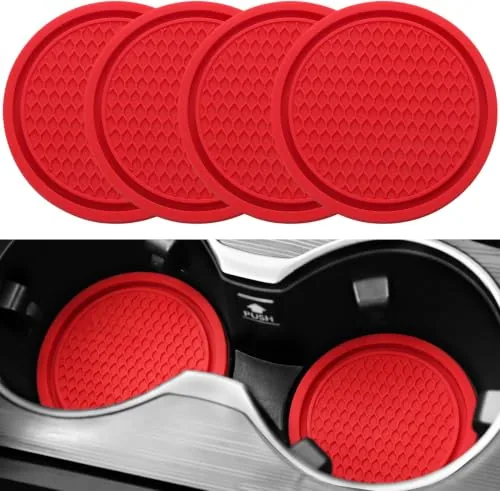
Inside, the parts that suffer are the ones people touch and the ones that hold shape. A silicone cup holder insert survives a hot cabin without going sticky, which is the practical reason so much of our interior range is silicone rather than a cheaper compound. Leather and vinyl surfaces age fastest under direct sun, which is where a shade earns its keep over years rather than over an afternoon.
The surfaces you actually touch
Cabin air temperature is the number in the experiments because it is the number a probe can measure cleanly. It is not the number that burns a hand. Sunlight lands on solid surfaces and turns into heat there, so a black steering wheel, a metal seat belt buckle and a dark dashboard all run hotter than the air around them. Lighter surfaces run cooler than dark ones, and matt surfaces cooler than gloss, for the same reason a dark shirt is worse than a white one in August.
This is the practical case for a shade over the alternatives. Cracking the windows changes the air a little and the surfaces almost not at all. A shade removes the sunlight before it reaches the wheel and the dashboard, which is where the heat you feel in the first minute of a drive is stored.
It is also the reason a cover for the wheel is not a silly product. Anything that keeps direct sun off the rim you have to grip is doing the same job as the shade, in the one place your hands land first.
Dogs, and the same arithmetic
The weather service sentence quoted above names children and animals in the same breath, and the reasoning is the same. A dog cannot sweat through its skin, cools mainly by panting, and is closer to a hot floor than a person is. The window gap that feels like a compromise is the workaround NHTSA specifically says does little.
There is no accessory answer here and we are not going to invent one. A shade is for the car, not for what is in it.
How to read a claim about degrees
Accessory pages are full of temperature claims, and most of them are unfalsifiable as written. A shade that promises to keep a car twenty degrees cooler has not said cooler than what, measured where, at what outside temperature, after how long, with which windows facing the sun. The same shade in the same car can produce very different numbers on two consecutive afternoons.
Two rules make the claims readable. First, prefer a source that describes its own experiment, as the weather service does above, over one that quotes a number with no method. Second, treat surface temperature and air temperature as different claims, because they are: a shade changes the first far more than the second.
For the same reason, our own pages state the size of a shade and the material it is cut from rather than a degree figure. We can measure a shade. We cannot measure your afternoon.
Parking, which is free
- Face the car away from the afternoon sun rather than into it, and the windscreen stops being the biggest target.
- Shade from a building moves. Shade from a tree moves and drips. Neither is a plan for a whole day.
- In a multi storey, the top deck is the hottest floor by a distance.
- A cracked window is not a cooling strategy. NHTSA has already said what it is worth.
What a hot cabin does to the parts inside it
Heat is the main ageing mechanism for everything soft in a car. Vinyl and leather dry, shrink and crack at the seams. Adhesive on badly made trim lets go and a panel starts to rattle. Cheap plastics go chalky where the sun lands and stay that way. None of this happens in one summer, and all of it happens in five.
That ageing curve puts material choice under more pressure in a car than in a house. Silicone holds its properties across the range a cabin actually reaches, so our interior parts are silicone where the part is handled. Rubber is cheaper and better at abrasion, so it goes where a part is rubbed rather than squeezed. Aluminium is anodised so that a hot dashboard does not bake a painted finish into something flaky.
Winter is the same problem backwards
The same piece of glass that lets heat in is the one that grows frost. A shade used in reverse over a frozen night saves scraping, provided it is a shade rather than a thin foil sheet that freezes to the glass. This is a genuinely useful second season for a part that otherwise lives in a boot for six months, and it is worth checking that the one you buy is stiff enough to be peeled off rather than chipped off.
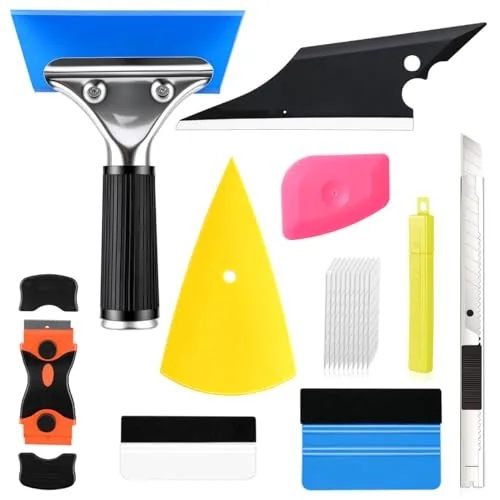
If you scrape instead, scrape with a blade meant for glass. A hard plastic edge with grit under it will mark a windscreen, and the marks sit exactly where the wipers put water in your eyeline at night.
The short version
- A closed car passed 100 F within six minutes on a 94 F afternoon in the weather service's own experiment.
- A reflective shade protects surfaces and slows ageing. It does not make a parked car safe.
- Rolling the windows down or parking in shade does little, according to NHTSA.
- Measure the glass, not the car model, and fit the reflective face outwards.
- Never leave a child or an animal in a parked car, for any length of time.
Sources
- Heat in Vehicles Can Become Deadly Quickly, National Weather Service, Louisville. Read 14 August 2026. A measured experiment: a probe in a parked van on a 94 F afternoon.
- Heatstroke: children in hot cars, National Highway Traffic Safety Administration. Read 14 August 2026. How fast a child overheats in a parked car and what does not help.
Nothing on this page is medical, legal or engineering advice. Where a public authority is quoted, the quotation is word for word and the link goes to the page we read.