Window film: the federal standard, the state rules and a clean install
What the federal glazing standard actually says, why the number you are allowed to fit is a state matter, and how the tools in a film kit decide whether the job looks bought or looks fitted.
Window film is the rare car accessory that two sets of rules govern at once. There is a federal safety standard covering the glazing in a vehicle, and there is a separate state rulebook covering what may be added to it after the car leaves the factory. Most arguments about tint happen because people treat those two as one thing.
This guide separates them, then covers the part we actually sell: the kit of tools that decides whether film goes on flat or goes on with a crease down the middle. It is not legal advice. Where the law is involved, check your own state's current rules before you buy film, not after.
What the federal standard is for
Glazing in vehicles is covered by Federal Motor Vehicle Safety Standard 205, published in the Code of Federal Regulations. Its scope is broad:
This standard specifies requirements for glazing materials for use in motor vehicles and motor vehicle equipment.
Office of the Federal Register, eCFR, 49 CFR 571.205, Standard No. 205: Glazing materials. Read 14 August 2026.
And its purpose is worth reading slowly, because it is not the one most people assume:
The purpose of this standard is to reduce injuries resulting from impact to glazing surfaces, to ensure a necessary degree of transparency in motor vehicle windows for driver visibility, and to minimize the possibility of occupants being thrown through the vehicle windows in collisions.
Office of the Federal Register, eCFR, 49 CFR 571.205, Standard No. 205: Glazing materials. Read 14 August 2026.
Three aims, and only one of them is about seeing out. The standard is mostly about what happens in a crash: glass that breaks in a way that does less damage, and windows that keep people inside the vehicle. Visibility is the middle clause, and it is the clause that tint touches.
The standard also reaches past the factory:
Glazing intended for aftermarket replacement is required to meet the requirements of this standard.
Office of the Federal Register, eCFR, 49 CFR 571.205, Standard No. 205: Glazing materials. Read 14 August 2026.
That sentence is about replacement glazing rather than about film, but it sets the tone of the whole area: what goes into a car's windows is regulated. The fact that a part is sold in a shop is not by itself evidence that it is legal to fit where you live.
Why the number is a state question
The figure people argue about, the percentage of light a window passes, is enforced by states rather than being one national number for tinted film. States set their own limits, they set different limits for the windscreen, the front side windows and the rear, and several allow a medical exemption on application. Some measure reflectivity as well as transmission. A film that is ordinary in one state is a ticket in the next one over.
Because of that, no single percentage holds everywhere. The honest instruction is the boring one: look up your own state's current rule for each window before ordering, and buy film that meets it rather than film you intend to explain later.
- The rule usually differs between front side windows and everything behind the driver.
- The windscreen is usually treated separately, often as a band along the top only.
- Reflectivity is regulated in some states even when transmission is legal.
- A medical exemption, where one exists, is a document to carry rather than a defence to argue.
What film is made of, and what that changes
Film is a laminate: an adhesive layer, a base polyester film, whatever gives the film its properties, and a scratch resistant coat on the inside face. What sits in the middle is where the differences live.
| Type | How it works | Trade-off |
|---|---|---|
| Dyed | Pigment absorbs light | Cheapest. Fades over years and rejects the least heat. |
| Metalised | A thin metal layer reflects | Rejects heat well. Can interfere with radio, keyless entry and toll transponders. |
| Carbon | Carbon particles absorb infrared | No signal interference, holds colour, costs more. |
| Ceramic | Ceramic particles reject infrared | Best heat rejection for a given darkness, most expensive. |
The point worth taking from that table is that darkness and heat rejection are not the same property. A light ceramic film can reject more heat than a dark dyed one, which matters if your state limits how dark you may go. Buying darker is not the same as buying cooler.
The install is a cleaning job with a squeegee attached
Almost every failed film job fails for one of three reasons, and all three happen before the film touches the glass.
- Dirt. Every speck under the film becomes a permanent bump with a halo around it.
- A dry surface. Film laid onto glass without enough slip solution grabs where it lands and cannot be positioned.
- Impatience with the shrink. Curved glass needs the film to be shaped before it goes inside, not fought into shape afterwards.
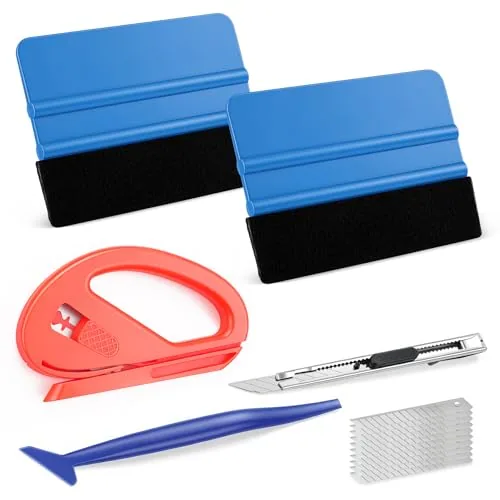
The tools that come in a kit exist for those three problems. A hard card squeegee pushes solution out from the centre. A soft edged blade works the film into the seal at the bottom of the glass. A blade scrapes the glass clean before anything else happens, and a lint free cloth keeps it that way. None of it is exotic and all of it is the difference between flat film and a bubble farm.
A working order that avoids the common mistakes
- Work indoors or in shade. Direct sun dries the solution before the film is positioned.
- Clean the glass twice: once to remove the visible dirt, once with a blade for the film you cannot see.
- Cut oversize, shrink on the outside of the glass, then trim to the line.
- Wet the glass and your hands. Dry fingers on wet film leave marks that never come out.
- Squeegee from the centre outwards, in overlapping passes, and finish the edges last.
- Leave the windows up for the curing period stated on the film. Hazing and small water pockets during curing are normal and clear on their own.
If the edges lift after a few days, the usual cause is solution trapped under the seal rather than bad film. A crease means the film moved after it had grabbed. Neither is fixable by pressing harder.
Taking old film off, which is the harder job
Film that has been on a car for years is a different task from film that went on last week. The polyester layer becomes brittle and tears into strips instead of peeling in one piece, and the adhesive stays behind. On rear glass there is an additional hazard: the defroster lines are printed onto the inside surface, and a scraper used with confidence will take a line with it and leave a stripe that never clears again.
- Heat the film first. Warm glass releases adhesive that cold glass holds onto.
- Peel at a shallow angle and slowly. A fast pull tears the film and leaves the glue.
- On rear glass, work along the defroster lines rather than across them, and never with a metal blade.
- Expect the adhesive to need a separate pass with a solvent and a cloth after the film is off.
A rear window is the one piece of glass where paying somebody else is often the cheaper answer, because a broken defroster grid cannot be repaired the way a bad film job can be redone.
The windscreen band and the strips people forget
Most states that allow anything on a windscreen allow a band along the top, measured either as a number of inches or as everything above the manufacturer's own marked line. That line exists on most modern windscreens: a short mark at the edge of the glass, usually labelled AS1, which is the boundary the rules refer to. Fitting a band to that line rather than by eye is the difference between a legal strip and an expensive one.
Two smaller pieces get overlooked in kits and then cause the visible failures. The tiny triangle of glass at the leading edge of a front door needs its own cut piece and is the most common place to see a bubble. And the curved corners of a rear side window need shrinking exactly like the big glass does, on a piece so small that people try to stretch it instead.
What a kit should contain, and what it usually does not
| Piece | What it does | Watch for |
|---|---|---|
| Hard card squeegee | Pushes solution out from the centre | A card with a chamfered edge, not a flat rectangle that digs in. |
| Soft edge blade | Works film into the bottom seal | Rubber that is soft enough to bend around the seal. |
| Utility blade or scraper | Cleans glass before the film goes on | A holder rather than a bare blade, and spare blades. |
| Lint free cloth | Final wipe and edge work | Microfibre. A paper towel sheds exactly what you are trying to remove. |
| Spray bottle | Slip solution | A fine mist. A jet floods the door card instead of wetting the glass. |
The piece most kits skip is the spray bottle, on the theory that everyone has one. Everyone has one full of something else, and film adhesive is not fussy about which residue it picks up. It is worth having a bottle that only ever holds water and a drop of soap.
How long film lasts, and what kills it early
Good film on a car parked outdoors is a multi year part rather than a permanent one. Purple fading is the classic end state of dyed film, where the dye breaks down and the colour shifts. Delamination shows up as a milky haze between layers. Bubbling along an edge is usually installation rather than age, and bubbling across a whole pane usually means the adhesive has failed.
Two things shorten the life more than sunlight does. Ammonia based glass cleaners attack the film's coating, so clean the inside of a tinted window with a mild soap solution instead. And an abrasive cloth on the inside face scratches the coat that was supposed to stop scratches, which is the same argument for microfibre as everywhere else in a car.
Film, shades and where each one wins
Film and a windscreen shade solve overlapping problems from different directions. Film works on the side and rear glass, all the time, including while driving, and it is the only one of the two that reduces glare on the move. A shade works on the windscreen, only while parked, and it is the only one of the two that can be moved between cars. Neither replaces the other, and our parked-car heat guide covers the second one properly.
One caution about combining them. Metalised film and a metal-faced sunshade both reflect, and both can interfere with equipment mounted on the glass. Toll transponders, rain sensors and some camera-based driver aids sit behind the windscreen for a reason, and covering or coating that area is worth checking against the car's manual first.
Doors that roll down, and the week after fitting
A front side window is the hardest piece of glass in the car to film well, and not because of its shape. It moves. The top edge of the film sits where the glass meets the rubber seal, and the first time the window is lowered that edge is dragged through the seal at an angle. Film cut a fraction too high catches, lifts and peels itself back in a neat curl.
The answer is patience rather than technique. Leave the door windows up for the period the film maker states, which is commonly a few days and longer in cold or damp weather. When they do come down for the first time, lower them an inch and check the top edge before going further. If the edge has lifted, the film has not finished curing and a further day up costs nothing.
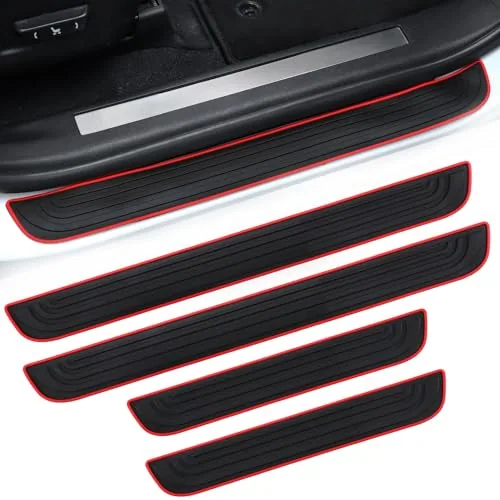
The same reasoning applies to the rubber seals themselves. A seal that has hardened and split lets water sit against the glass edge, and water at an edge is how film lifts long after the install was blameless. Replacing a strip of edge trim is a ten minute job and a fraction of the price of redoing a window.
What we sell into this
Our part of the job is the kit rather than the film chemistry: squeegees, blades, cards and the cloths, in sets that hold together. The pages state what is in each set and the sizes of the pieces, because a kit that turns out to be three tools and a promise is the most annoying purchase in this entire category.
The rest of the responsibility is yours and the law's. Read the state rule, buy to it, and take the time on the glass. A film job that is done properly is invisible, which is the same standard every other part in this catalogue is held to.
Sources
- 49 CFR 571.205, Standard No. 205: Glazing materials, Office of the Federal Register, eCFR. Read 14 August 2026. The federal standard for glazing in vehicles, including replacement glazing.
Nothing on this page is medical, legal or engineering advice. Where a public authority is quoted, the quotation is word for word and the link goes to the page we read.